My Trip to Spain and Portugal

Day #1
Oct. 24
Bilbao is a very interesting city. It is surrounded by mountains in a valley. It is a city that has
been transformed. It used to be a very industrial, polluted, smelly city. In 1983 there was a huge
flood. This was the rock bottom of the city. Fifteen years after the flood, the Guggenheim
museum was built. This was the start of the resurgence and transformation of the city. There
was a tremendous amount of opposition and controversy surrounding the building of the
museum. A bomb was actually planted outside the museum the day before it was supposed to
open. One police officer was killed deactivating the bomb. It cost $300 million to build the
museum, but the city made it back in 4 years. The mayor of Balboa, Azkuna, was extremely
forward thinking and planned for the future. He was a retired doctor in his 70’s, not a career
politician. The building of the Guggenheim started a resurgence. The river was cleaned up, and
public transportation was greatly improved. The subway system was actually completed 2
years before the museum and greatly transformed the city.
The Guggenheim is gorgeous! It has titanium on the outside. This was bought at a very good
price from Russia. They were retiring their submarines at the time. I think it is the most beautiful
building I have ever seen. Going into it is like two experiences. The building itself and the
exhibits. The exhibits were modern and controversial. The one I found most fascinating was a
huge room with various collages on the walls. In the center was the Pledge of Allegiance. So
my first reaction was, “They are more patriotic to the U.S. than we are.” But then words began
to be substituted. The ideals were substituted for the reality.
The huge building that used to be a storage facility for wine was transformed into a public
space for its’ citizens. From the outside it still looks like an old building. It was the first
recommended site for the Guggenheim but the architect, Frank Gerry, shot it down and chose
the site near the river. It is called the Alhóndiga Center (Winery). The official name Azkuna
Zentroa center. Inside is amazing. It has the central public library, a movie theatre, a sports
center, a gym, studios for local artists, and a swimming pool. It is designed to take care of the
body and the mind. Free concerts sometimes take place here. It is for the citizens of Bilbao.
Basque soccer has become a point of national pride with a huge stadium. There is no parking
lot, so everyone has to come on foot or by public transportation. The city is abuzz when there
is a game. In order to be in the soccer league, you need to have been born in the Basque area,
which is a large area covering part of Spain into France. The Basque have their own language
and sense of pride separate from Spain or France and collect their own taxes. They are semi-
independent.
Pintxos are a big deal here. These are small bites of many varieties of delectable small
appetizers. Most are served on bread. The tradition is to go from one bar to another, have a
drink and a pintxos at each. I went out of my comfort zone and had a leak pincho with an
anchovy on top. I actually really liked it. Our guide ,Thomas, bought us a treat that was
amazing. It was a pastry that was mostly meringue. It was one of the best pastries I have ever
eaten!

Day #2
The Basque region was never captured by the Romans, most likely because it’s so hilly. The language is more than 2000 years old, making it older than the Roman language. People were forbidden to speak the language for the 40 years that Franco was in power. They could actually be killed for speaking it. When Spain became a democracy in 1975 the language was revived. The Basque language does not resemble any other language. When printed on signs it has a boxy look.
Today we went to Gernika. You may be familiar with Picasso’s famous painting depicting the gruesome event that happened in Gernika. Before WW2, Franco wanted to get on the side of Hitler. He invited the Germans to test out their bombs on his citizens that did not support him. Most of the Basques were more liberal, they were a republic and did not support Franco. This event happened on April 26, 1937. The Spanish Civil War was happening from 1936-1939. The bombing took place on a Monday when more civilians are in Gernika for marketing day. Over a period of 3.5 hours, 40 tons of bombs were dropped and about 2000 people were killed. The entire city destroyed. First they bombed the buildings. As people ran out from the burning buildings, they were bombed and then shot. This was not aimed at military targets. It was strictly planned to kill as many civilians as possible. We went to the Peace Museum to hear the history. The town was disseminated and no one would do the construction work since they didn’t think they would get paid. So, to add insult to injury, Franco, who won the war and became the dictator, funded the reconstruction but insisted on becoming an honorary member of the town. His plaque and statue were removed once Spain became a democracy in 1975. During Franco’s rule the bombing was blamed on the republic, saying they did it to themselves. Since it was a dictatorship with heavy censorship the people did not know the truth until they finally became a democracy.
Some important sites were preserved: the bridge, the church and the oak tree. Basque laws were made under the Oak tree for centuries. This, again, shows that the bombing was meant to kill the people who opposed Franco, not for any military advantage.
Picasso started his painting within days of the Gernika destruction. You can see a lot of symbolism in the painting. It was a statement against war. The painting started being shown in Paris and went to New York for quite a while. Picasso wanted the picture sent back to Spain when peace was established. It is currently in Madrid, but the people of Gernika want it brought to it’s town.

More about the Basque culture: People form friend groups, cuadrilla, when they are about five years old. They remain friends for life no matter what path any of them take. This is a very strong bond. We saw the preparation for a cooking contest with these friend groups competing to make the best rice dish. The family is also really close. Most families own a large house in the country where the extended family gathers. This is a type of house is called a caserío. They generally live in apartments in the city for work. Since most men were fishermen or whalers, the women took care of everything at home. The homes were inherited by the oldest child, man or woman. Since women generally live longer more and more homes became owned by women. They are very important in Basque culture. Even if a home is sold, the original family has priority rights if it is ever sold again.
We went to a Basque village and saw the church with a hand ball court right next to it. We had flat corn bread, talo, with toppings and then made our own talo.

On the way home we went across the river on a transporter bridge. It was like a ferry that was suspended from the very high bridge. This is the oldest transporter bridge in the world.

Tonight we went to a home hosted dinner with local Basque family. My dinner was delicious, with many traditional Basque foods. We had several different appetizers such as: asparagus with jam, salmon with cheese, and pork pate with jam. Next we had a tomato vegetable soup. The main course was an orange chicken with potatoes and carrots. For dessert we had Greek yogurt with strawberry jam. The company was delightful! Our host was a single divorced woman with two daughters. She and her friend joined us. The conversation flowed and was very lively.

Day #3
Today we walked the Camino de Santiago as Pilgrims. It really did have a magical feel to it. This has been a pilgrimage since the 19th century. As legend goes, a hermit Pelayo found the grave of St. James the Great as indicated by the stars. The bishop Theodomir came and confirmed it. After the king visited the site, a chapel was built where the body was found. St. James was preaching in Iberia, the Spanish Portugal border. He was renowned for converting the “pagans” to Christianity. He traveled to Jerusalem where he was killed and martyred. His body was supposedly sent back on a stone boat and arrived at the coast of Galicia in 44 AD. His tomb ended up 70 miles further inland. His body was forgotten for 8 centuries. The chapel to St. James, that was built on the site is a main pilgrimage site in the Catholic religion. There are many different branches of the trail, depending on where people started walking. From the 12th century onward, it became more popular to walk the trail. It was believed that all your sins would be forgiven if you made the pilgrimage. In order to prove you made it people brought back scallop shells and attached them to their sacks, hence the scallop symbol denoting the trail. The pilgrims were given free lodging and meals along the way. Hostels were set up for pilgrims. (See picture of a hostel still in use). The French trail is the most used. Last year 220,000 people completed the trail. In 1984, only 300 people completed the pilgrimage, but with the advent of social media 300,000 completed it last year. A yellow arrow and a sea shell mark the trail. The yellow arrow started with a “mistake”. A mayor of a town bought too much yellow paint and decided to use it to indicate the trail. Other mayors followed suit.
The little town where we started and ate at only has 19 inhabitants but two bars. It is owned by the church. The hostel that we saw used to house a hospital. Now it is just a hostel offering lodging and food for donations. Next to it is a structure that was, and is still, used for burial. Part of the trail is called “The Oak Forest of the Witches”. Four hundred years ago 4 “witches” were burned here in order to lay claim to their property.
Hospital turned hostel
Picture of the trail
We had a delightful lunch with Gonzalo a troubadour. He is a nature photographer, gardener, and singer. We had a great time singing and dancing and celebrating Tammie’s birthday.
We drove back to Pamplona, did some exploring, and met Gorka, a man who has run with the bulls over 150 times. We heard all about the festivities that start on July 6th and go for 8 days. Everyone wears white shirt and pants with a red sash around their waist and neck. It’s a sea of red and white. This festival is HUGE in Pamplona, with over 20,000 people participating. You see it’s influence everywhere, even with signs counting down the days and minutes to the start of the event. 6 bulls are corralled and then run from the corral to the arena. It is only about half a mile and takes the bulls a couple of minutes. Someone started running with them centuries ago and it became a tradition with more and more people running with the bulls. These bulls are specially bred for the bull fights. It is a huge money making business. Fences are put up to keep the bulls contained. The squares on the ground to support the fences are centuries old. Anyone can run with the bulls and it is free. The only restrictions: you have to look 18 years old, you can’t look drunk, and you can not carry any electronics. You have to be at the coral half an hour early to run with the bulls. There are 12 shepherds that guide the bulls. These are the only professionals. Gorka finally gave up his bull running when he fell and a bull tramples his head. He had 24 fractures in his head, was in the hospital for 15 days, and was put in a coma for 5 days. This is why Thomas calls him “Crazy Gorka”. What I think is even crazier, is his son is now doing it. But that’s just my opinion.
Day #4
The bull fighting is a controversial issue. There are two parts of the festivities: the running with the bulls and the bull fight. The running with the bulls started in the Middle Ages. Most people go to see the running with the bulls and do not see the fight. Bull fighting is centuries old and dates back to Mesopotamia, prehistoric times. Spain has been doing it since the Roman time. In the last 50 years there have been animal rights protests and it is banned in many areas.
The pros:
1. It is part of the culture and should not be lost.
2. Financially it brings in millions of euros a year.
3. The bulls get treated very well before the bull fight and it is a valiant brave way for them to die, rather than being sent directly to slaughter. These bulls are specifically bread for the bull fight and would not even exist without it.
The cons:
1. It is no longer for our times when animal welfare is now in our psyche.
2. It is a very small percentage of people who attend, younger people are not interested.
3. It is a great money spender. Public money is spent raising the bulls, broadcasting, etc.
4. In addition to the bulls, it is also dangerous for people. People can die and many are injured.
Politically people who are generally pro Franco, the nationalistic side, are for bull fighting. And against are more like the republic anti Franco and anti fascist. The solution could be to keep the celebration but do other events such as bull acrobatics, etc so bulls do not get killed.
We traveled to Ubide, which is a very small town with only 175 inhabitants. The population is growing since the price of housing is lower, and public transportation is good into the cities. There are no stores in Ubide but, as usual, there are two bars. A mobile van comes with groceries, and a baker delivers bread to your home. This area smuggled supplies like axes and shovels in the 1600s to the U.S, before it became independent. Basque is one of the oldest democracies in the world. And Adams came to the Basque region before the U.S. was established to see see how it was run.
We went to an archeological research center. In the lab we saw many cardboard boxes. These contained bodies. The plastic bins contained artifacts. They requested no pictures be posted on social media. This is an independent research company. They clean, analyze and organize remains. They do both planned excavations, such as when they are going to build a road, and single projects, that can take 5-10 years. Yesterday we saw the place where bodies were buried next to the hostel that used to be a hospital. They are analyzing bodies from that cemetery. It was so interesting. Fran showed us a skull that had a hole though it made from a sword. As a company they have trained people even from CSI. They do not try to reconstruct history; rather they try to fill in the gaps. They are able to calculate the approximate age of the person and the likely cause of death. Since teeth are formed when still in childhood, it is possible to see where the person was brought up. The lower ribs can tell where a person lived the last ten years of life. Attachment platforms are developed on the bone with bigger muscles. African American people fought in the wars. They were set free when their masters died, but had few opportunities so many joined the army.
Pelota, handball played with a hard ball, is the national sport. Even in this small village, they had a large handball court.
We walked another part of the Camino de Santiago, the French way, which is the most popular. We walked the small town of Castrojeriz. We were serenaded by a local called Antonio when we first walked into the bar. He was an older gentleman and sang directly into my face. This is a beautiful ancient town that grew in a line along the path. Some ancient houses were built into the mountains as caves.
We heard the pros and cons of the windmills which are product green energy. I can fill it in if you are interested.

We are staying in Leon, a beautiful city with a lot of history dating back to the Romans. We took a walking tour and saw the building that Antoni Gaudí designed. It was originally designed as a shop for three families to sell textiles. It was designed to resemble the Gothic church. Later it was bought by a bank and gradually lost its original design as they made more and more offices. It is now a museum. We saw an old Gothic church that has the second most stained-glass windows of any cathedral in the world.
We had a lovely dinner in a restaurant that opened just for us. Many restaurants in the area are only open from Wednesday to Saturday due to a lack of workers. Our dinner consisted of many different family style plates served one after the other. Another gastronomical experience! And, as in every meal we have had, wine flowed freely.
Day #5
From Leon we drove out to the countryside for our Day in The Life. We went to a farm, in Morgovejo, where the owner, Carmen, lives with her husband Emilio. She is an animal therapist for special needs children. She combined her passion for the countryside with therapy. They have over 400 sheep, goats, 42 horses, and ponies. Most of the animals she rescues from the slaughterhouse or people give them to her when they can no longer care for them. They come here, are well taken care of, and eventually die a natural death. Carmen creates games and activities for the children helping them with their whole body, fine motor, and cognition.

We saw the goats and sheep first. I was overwhelmed by how many they have. They are controlled by dogs. When the dog raises its tail they all freeze. The dogs keep them together when they wander in the forest. Only the “naughty” ones wear a bell. We got to hold a lamb that was just born half an hour before.
Therapy sessions are one hour a day. She now gets referrals from doctors and schools, but it took quite a while to get established. She demonstrated what a session on a horse would look like. It was very interesting, with the client going in various positions on the horse in order to develop strength. She would give the client choices of blankets with various textures and would even put colored rings on the horse’s ears and tell the client to get a specific colored ring.
We made cheese and a natural goat lotion. Then ate a delicious soup, which was made in a “railroad pot” (olla ferroviaria). This is a very large pot that has a place for coals under the pot. It was used by railroad workers who were on the trains for sometimes 7-10 days. It is like an old-fashioned crock pot. The soup would cook for several hours. It was mostly used from 1880-1980.
In the evening we had a surprise learning and discovery activity. We stopped at a grocery store and bought: eggs, chocolate, flour, potatoes chips, milk, and biscuits. We were kept in the dark as to what we were doing with the food. Eventually we got to a convent. The nuns in this convent take a vow of poverty and never come out. Thomas, our guide, rang the bell. We were let in to a small entryway. The nun who greeted us was not visible to us. We could only hear her. She could see us through a hole. Thomas spoke to her. She seemed delighted to have us there. The bag of food was left on a shelf that rotated into the convent. We asked them to pray for world peace and then Thomas asked it anyone else had any specific prayers they would like said.
The evening was spent wandering the stores and going into to the gothic church with a phenomenal amount of stain glass windows.
Day #6
On our way to Santiago we went by an ancient monastery that has been converted into a five star hotel. This was featured in the movie “The Way.” We stopped in Astoria and saw the Episcopal Palace which was built in the Gothic style by Anthony Gaudy. This town is the entrance to the Maragotos region (maragatería). This was the first place in Spain and in Europe to make chocolate, in the 17th century. This region was known for its trade. They brought seafood from the Galicia to Madrid. And brought back dried meats, peppers , etc to the coast. They traveled with carts and donkeys and had a distinct colorful way of dressing. In the 16th century they began to settle halfway between the ocean and Madrid. There was some agriculture and small farms developed. The people in this area had their roots with the Moors, so there is a lot of Moorish influence. They were forced to convert and the area is now predominantly Catholic. They are known for their hearty stews that they cooked in the railroad pots and ate along the way.
We stopped at an authentic Pilgrims hostel. Jesús, at 83, has been welcoming Pilgrims all his life. It was quite rustic with bunk beds very closely spaced. It can sleep 80 people in a very small area. There is a communal kitchen. As we are getting closer to Santiago, we met more Pilgrims walking with backpacks. They hang a scallop to the their pack as proof of completing the journey.
We had a presentation on bee keeping with Tania (her nickname is Txiri) and how they make honey. Each bee has its own job. Without the bees, who carry pollen from plant to plant, we would have no food. So in order to preserve the bees do these 4 things: 1. Do not use pesticides. 2. Buy local honey not honey from the supermarket. 3. Have flowers in your yard. 4. In the summer have a pot of water with sticks in it.

We ate at a typical Maragato home that has been converted in to a small hotel. It has a courtyard in the middle, made of stones, with very small windows to the outside. In the winter they would gather in the kitchen; in the summer they were in the courtyard.
Galicia is the rainiest part of Spain. It has been raining a lot since we got here. Forty percent of Spain’s seafood comes from this Galicia region of Spain. Octopus, pulpo, is
Day #7
October 31
Santiago is built on a hill. In the Middle Ages so many people came to have their sins forgiven that there was an orphanage, a jail, and a hospital. These have all been converted into other functions now. The cathedral has four courtyards, one on each side. When the pilgrims came they had to take off their clothes and they were burned, Then they went into a fountain to be washed, and changed their clothes. They were given simple clothes if they did not have a change. There is a holy door, supposedly all your sins are forgiven when you go through this door. It is only open on the years that July 25th falls on a Sunday. Then it is opened for that year.
There is a convent next to it. Perhaps there is a tunnel for the cloistered nuns to go under the stairs to the cathedral.
There used to be a sculpture of a woman breastfeeding and one pregnant. Since the statue of St. James was looking in her direction, the church, in the 17th century, ordered her breasts to be flattened, instead of changing his gaze. The women were so outraged that they started making boobie cheese, which is delicious by the way.
I spent the afternoon shopping with my new friends. I had Paella for dinner which was yummy!
Tonight is Samaín, which is the day that the dead can communicate with the living. There are many customs, such as wearing masks, decorating pumpkins, and distributing candy, that have been adopted into our Halloween.
Day #8
Today we went to Pontevedra and Combarro. Some people, over the years, continued their pilgrimage from Santiago to the coast, which takes another 3-4 days. In the first century the Romans came when it was still in its natural state. They began to build roads and structures and these became important harbors, particularly for fish. There is still a bridge that was built by the Romans. Pontevedra is still known for its fish, but it is also known for artisans and is a summer place to visit. The seafood is extremely fresh in this area. From Tuesday to Saturday you can get fresh fish that was just caught the night before. The best seafood goes to famous restaurants. There are 7 Michelin star restaurants is the area. Mostly they serve seafood. Although there are paper factories in the area, they are required to check the water every two days for pollutants and to notify fisherman if it gets to a certain level. So the seafood is from very clean water. Combarro is actually build on a huge rock. So there is only stone under the structures.
There is a statue of a Galician writer named Ramon Valle Inclán. His book “Bohemian Lights” is translated into English. He is represented with a long beard, a hat, and glasses. He lost his left arm after it got infected after a bar room brawl. There is another statue of another writer, Alexander Balboa, who wrote in Galician during Franco’s time, when speaking anything but Spanish was forbidden. He was sentenced to death for it. Before he was executed, he wrote a poem about speaking Galician. Ironically, Franco was Galician. People are not proud of this fact. There is a parrot sculpture. A parrot, who belonged to a pharmacist used to fly around the town everyday. He was poisoned in 1912 and is celebrated every year. People wear huge parrot costumes.
Ten percent of the population is tourists who come daily. This affects some people in a positive way and other negatively. Housing is very expensive and hard to find. Families live in generational houses with 3 generations living under one roof.
We had churros with chocolate. Yum!
We met a woman called Marina who collects clams for her living. It is currently very well regulated so as not to deplete resources. They mostly gather the clams during low tide. If they are too small they need to be put back in the water to mature. Before 2000 there were no regulations, but it was not sustainable. Now you need a license and need to work some days without pay. Two days a month they have to take the baby clams back where they can naturally grow bigger. It is hard work, being in the sun, getting cut with barnacles, etc. Because of this, they are allowed to retire a little earlier than the rest of the population.
We had lunch at an amazing seafood restaurant. It was one of the best meals I have ever eaten. We had steamed clams, a pocket that had crispy dough around a cream cheese and shrimp combination, and a rice and seafood main course that was phenomenal. For dessert we had cheesecake. And the wine flowed freely, as in every meal, with the exception of breakfast, that we have eaten.
Day #9
We headed into Portugal today. On the way we heard about the controversy of the eucalyptus trees. The tree was originally introduced by an Australian missionary. It is a very fast growing tree and is used to manufacture paper, so at first it was welcomed.
Pros:
1. It creates a lot of jobs in the paper industry.
2. It is fast growing and can be used within five years, so it is not labor intensive.
Cons:
1. It is fuel for forest fires which are getting bigger and harder to put out every year.
2. It produces a lot of emissions of CO2 into the atmosphere which fuels fires.
3. It takes over native species.
4. It takes all the nutrients and water, making the environment like a forested dessert.
There are more and more protests about the eucalyptus farms.

The Minho is a river that divides Spain from Portugal. We just drove across it without any check point, as they are both part of the European Union. It’s just like crossing from one state to another. Portugal is the size of a small state, whereas Spain is the size of Texas. The first settlements in the area date back to the Celtic occupation. The Portuguese language dates back to the Romans. The Visigoths took over the area and ruled from the 5th to the 8th century, until the Moors took over. The Catholics fought back against the Moors and took back their land in 1139 in the Battle of Ourique. The first king, Alfonso the first (Afonso Henriques), was put in power. In the 12th century, Portugal became an independent nation. In the 15th century they began to colonize and set up trading routes to India, Brazil, and Africa. It became a colonial empire. From 1580-1640 Spain took over Portugal. Portugal took back it’s country in the Restoration War from 1640-1668. In 1822 Brazil became independent. In 1910 Portugal became a Republic. In a period of 16 years Portugal had 45 different governments. It was a time of great instability. In 1926 there was a military coup and the start of a dictatorship, with António de Oliveira Salazar. There was no freedom of language or movement. He ruled from 1933-1974. Portugal was completely isolated, with Great Britain its only ally. Salazar put so much emphasis on the colonies that the economy of Portugal began to decline. In the end Portugal’s economy collapsed. On April 25, 1974, there was a peaceful revolution. The left wing of the military began to carry red carnations. It was called the Carnation Revolution. The dictatorship which lasted from 1933-1974 ended. Salazar had severe dementia at this point. Although he was officially still in power, due to his disease, Marcelo Caetano had the power at the time of the Carnation Revolution. In 1986 Portugal joined the European Union and gradually began to modernize.
We traveled through the Douro valley. It is a mountainous area with a lot of small villages. Those are called freguesías. It is known for its wines. You can see terraces cut into the hills with lots of vineyards. This area is perfect for growing the grapes but not for aging them. It was transported in barrels along the river to Vila Nova de Gaia –opposite the city of Porto, where the river meets the Atlantic Ocean. Grape brandy was added to stop the fermentation and this became port wine. Many of the names of the vineyards are English names since many English came to the area.
On the way we stopped in Guimaraes and walked the Portuguese Camino in Ponte de Lima. It was so picturesque! We had lunch in the charming village of Guimaraes. It was alive with a market. Lunch and shopping were in a charming courtyard.

We traveled on to our hotel/spa in the Douro. It is gorgeous! I have a balcony with a magnificent view overlooking the Douro river.
We had another delicious dinner half a mile away. Most of us chose to walk back over the bridge to the hotel.
Day #10
Nov.3
Today was the best day ever! We went on a river cruise down the Douro River. The mountains with the terraced vineyards along the way were gorgeous.
From there we went to the vineyard, Quinta de Portela do Baixo, for a wine tasting. It was such a picturesque setting. It was unlike any wine tasting I have ever been to. I completely lost track of how many glasses of wine we were served. We counted later-9! These were not small tastings but full glasses of wine. It was by far the most wine I have drunk at one time.
Delicious appetizers of food kept coming. We got so silly with the group of friends…who had so recently been strangers. I realized how much I liked these wonderful people and how I would miss them when the trip ended. This is what happens when you take a leap of faith and jump in as a stranger. O.K. Now I am a bit sentimental… only 3 days to go.
Day #11
Nov. 4
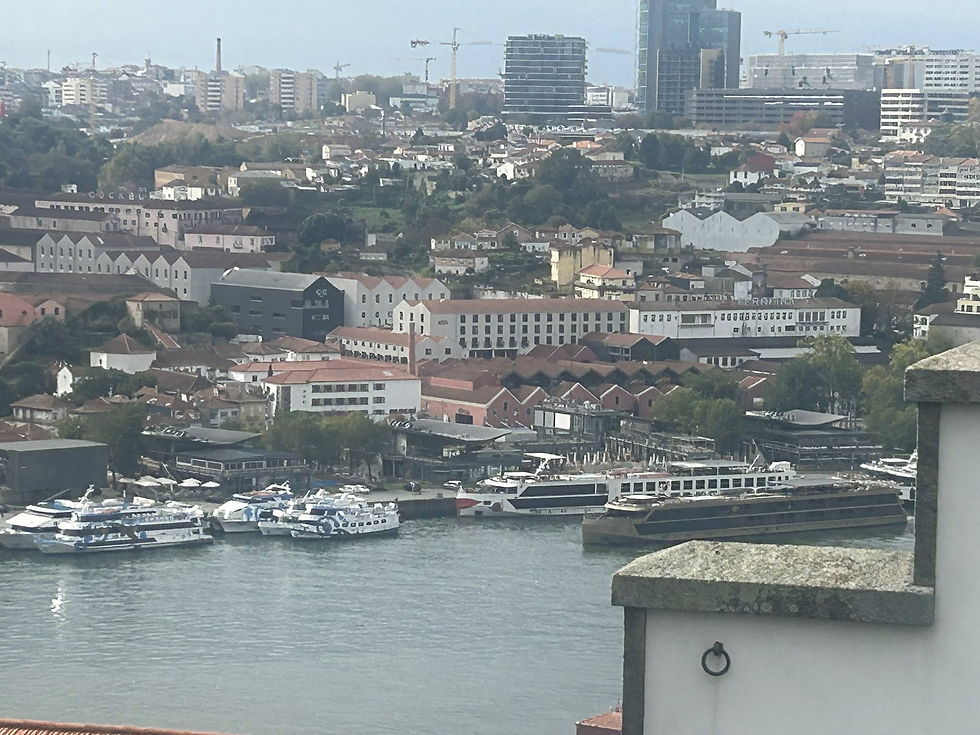
We are now in Porto, which is the second biggest city in Portugal. It is located where the Douro River meets the Atlantic Ocean. It was settled in Roman times, and much of the structures remain. It was important for shipbuilding. This is the first place that I have heard Jews and Muslims mentioned. Every other place has been overwhelmingly Catholic. There has generally been a tolerance for differences in this city, with everyone trying to survive. Since 1292, Portugal’s borders have not changed, making it feel a little like an island. The key word that our guide kept stressing is “survival”. People seem to be tolerant of differences in this city, as it is a country of immigrants. Since 1373 Portugal has been aligned with Great Britain. Port wines were developed in 1756. By adding brandy, it stopped the fermentation while being shipped to England.
There is an intriguing history of “false” kings and young queens that I honestly lost track of, so hereby a short summary of the story contributed by Thomas, our guide:
The Tale of the False Kings
Once upon a time, Portugal lost its king — and with him, a piece of its soul.
In 1578, the young and daring King Sebastian led his army across the sea to Morocco, dreaming of glory and crusades. But on the hot sands of Alcácer Quibir, the dream turned to dust. The army was crushed, and the king vanished — no one ever found his body.
Without a king, Portugal soon fell under Spanish rule. But the Portuguese people refused to believe that Sebastian was truly gone. “He will return,” they said, “on a foggy morning, riding a white horse, to save Portugal.”
That hope became a legend — Sebastianism — a faith that their king would come back when the nation needed him most.
And so began the age of the false kings.
The first appeared just a few years later, a ragged hermit wandering near Alcobaça, saying he was Sebastian returned from captivity in Africa. People wanted to believe him — they needed to believe — but the Spanish authorities hanged him before the story could grow.
Then came another in Ericeira, a fisherman’s village by the sea. He claimed to have escaped slavery, bearing scars and secrets only the king might know. But again, the hope was too dangerous. He was captured and silenced.
The third false king was the most daring of all. In Spain, a baker named Gabriel de Espinosa suddenly began speaking Portuguese like a nobleman. A friar and a few believers dressed him in fine clothes and called him “Your Majesty.” For a brief, flickering moment, people thought the miracle had come. But the Spanish crown saw through the disguise — the baker-king met his end on the gallows.
Even in Venice, years later, another man stood before the world and swore he was D. Sebastian. He too vanished into the shadows of history.
And yet, through all the impostors and disappointments, the dream lived on — that Portugal’s true king would one day return from the mist to restore the nation’s glory.
Centuries passed, and the people stopped waiting for a man on a white horse. But the spirit of King Sebastian — brave, tragic, and eternal — never truly died.
It became a symbol of the Portuguese soul itself: a longing for something lost, and a hope that never fades.
Tiles are used on many of the buildings. They are generally blue and white. Since this is such a damp city, maintenance of paint can be excessive. The tiles made it easier. Many old buildings are dilapidated but are kept in their original state because it is a UNESCO heritage site. The railroad station is decorated with large mosaic murals depicting Portugal’s history.

I did some shopping and got myself lost. I will not venture out alone again. We did a walking tour of the area. It is quite beautiful with markets, restaurants, and shops.
In the evening, we went to a Fado concert. It was a solo singer, one man and one woman, a guitar player and one other string instrument, the 12-stringed Portuguese guitar or fado guitar. It was beautiful. It was sung with so much passion and soul. It reminded me of Fiddler on the Roof.
The night ending with dinner on our own. I went with two friends to a charming restaurant and had appetizers.
Day #12
Nov. 5
Yesterday was such a delight! We were unable to do the optional tour due to weather conditions. So our wonderful guide, Thomas, came up with an alternate plan. We took a city bus to ____, a beach town. It was a double decker bus. We sat up top and had a panoramic view. We went to a local market, which was in a large modern building. It sold fresh fish, vegetables, fruit. We chose our own fish, which was just caught by local fishermen. Then it was brought to a restaurant within the market. The restaurant then prepared it for us. We added sides such as vegetables and potatoes. Most of the travelers had stingray. I had a golden fish. It was deliciously prepared and could not have been more fresh. On the way out we stopped at a hat store where they made all the hats by hand. Lynette got this adorable hat that suits her. We took a walk to the beach between downpours and waited in the visitor center for a break in the rain before boarding our bus back to Porto.
I did a little more shopping in the pouring rain with my new “sister”.
Dinner was at a restaurant in town. It had many courses and again was delicious with wine as freely flowing as ever. Our fellow travelers, Jean and Dwayne are leaving tomorrow so they treated us all to the creamiest gelato, which we all enjoyed and appreciated.
Day #13
Nov. 6
We met with a student, Dinato, from the University of Porto at a coffee shop. He was wearing the uniform of his school. It was a suit with a cape. Each school has it’s own dress with slight differences. He looked quite dapper. He said students look for occasions to dress up about once a week. Dinato to is a fourth year business major. The schools are totally separate from each other and you can not go from one to the other. The humanities, arts, and sciences are completely separate. Attendance is not mandatory, but you you need to pass exams. Student housing is not available and most students commute into the city. In 10th grade you have to choose between the sciences, humanities, or the arts. If you are on a track and decide to change, you have to start all over again. University costs between $600 and $1000 a year, but income is low, with $80,000 a year as the top bracket and $60,000 average.

The cafe where we met had an interesting student history. It is known as “The head lice or cooties cafe”. The cafe is 100 years old and students have been gathering here for a long time. They have been putting up plaques, with he oldest from 1936. From the 1930’s to 1954 the dystopian international police were looking to arrest people talking about freedom. Sometimes the police would come it and listen to conversations. The students combated this by setting up a signal system. Mirrors were put all around the cafe. If someone saw a suspicious person come into the cafe, they would scratch their heads to warn others, hence the nickname “head lice cafe”.
We had free time in the afternoon and my friends and I shopped.
We met for a final drink. Then went to our farewell dinner at a lovely restaurant near the hotel. Wine flowed freely, as usual.
Tidbits:
“There is no bad weather only bad clothing.”
“Either you start off as a tourist and end up as a Pilgrim or you start off as a Pilgrim and end as an alcoholic.”
I appreciate you for following along with me in my discoveries travelling through Spain and Portugal.
Until Next Time!
-Susan R. Schlank


Comments