My Trip to Costa Rica

Day #1
San José
I came a day early and did some exploring and orienting . This is the National theatre of Costa Rica built in 1897. The floor can rise or go up or down by 10 feet, so it can be used as a ballroom or theatre. There are huge cranes in the basement. It takes 10-12 people about twenty minutes to crank it up or down. Quite ingenious. The theatre was originally taxed to the wealthy coffee growers and commissioned by Italy. But after that the regular peasants were taxed to finish it. It is quite “bougie” (as my adorable guide said when he showed me the champagne fountains). I spent the rest of the day in the market going into stores, people watching, and enjoying the activity.

Day #2
Witches-Escasa
Today we went to the town of Witches-Escasa. The mural was donated by a Costa Rican artist who lived in the area. He made the ox cart for people to go into and pretend they are drunk. The story behind it: The men would take their coffee to market and on the way back when they had $ they would drink- the oxen knew the way home.
Then we went to a home where the man makes traditional masks and heard the legends. Three of us volunteered to be creative and make a face. I named mine Hernando, after the man who made the masks. I won by a clapping vote!!!! He gave me this witch mask as a prize.
Day #3
A lot has happened today. I have learned the whole process of coffee and I am in a rain forest. And it is pouring as I write this post.
Did you know that bananas are hermaphrodites? They have both male and female parts of the plant. The banana that we eat is the female part. We picked some bananas right off the stalk. Despite having a slight green color, they were amazingly sweet!
Now for the coffee process. I will really appreciate my coffee even more after knowing how much goes into it. Coffee is actually a berry and the drink comes from the seeds or pits. Each berry has two pits. It is a very long process. It starts in a greenhouse for a month, it is planted in the ground after about a year. It takes three years for it to produce the berries.
From flower to fruit it takes 4 months.a coffee bean has 4 layers. The beans are hand picked. I am posting a picture of one of our fellow travelers with a basket. It took 10 of us about 20 minutes to pick that amount.
The workers, from Nicaragua, get $4 a basket. The workers are provided with housing, power and water and are covered medically by the Costa Rican government while they are in CR. A worker can pick about 5-10 baskets a day. They are given metal chips and are then paid on Saturday. They can use those chips to buy necessities at the store. The owner will exchange it for cash later. Next it goes into a metal bin that holds 10 baskets. They get 2 of these so 20 baskets. They keep the bushes trimmed low so the workers can reach them. Two layers need to be removed. At this point they are still 52% water. They are brought to a room placed on the concrete where they dry. It takes from 10-22 days depending on the temperature. They have to bring it to exactly 11% water. It has to be mixed every hour.
Next it is brought to the chancador machine that removes the fruit from the seed. The skin is used for compost, liquor, beer, or to feed cattle. Nothing is wasted. Then it goes to the Pelling Machine- Peladora- after drying this takes the 4th layer off, the shell. After that it goes to Secadore - coffee drying oven. Then it goes to the roaster, where they bring it to different roasts-light to dark. Light has the most caffeine. The caffeine, which is an oil, that is taken off is sold to companies like coke. It is stored in big bags. Wow!
We went through a cloud forest and then entered the rain forest. I had to tell myself “I am in a rain forest.” So special!! There are 800 varieties of birds in the rain forest. It is so lush with waterfalls, vegetation and birds.
Day #4
We started the day rafting down the river. This was so much fun! We saw lots of birds, monkeys, etc. One group saw a slouth.

Some of us went to the pineapple tour. The best parts were actually outside the tour. We’ve been laughing about this incident all day. Wendy, our guide and William, our driver were looking out for wildlife. They spotted some birds. We jump out of the bus. Wendy sets up her tripod. The rest of us pile out with our binoculars. All of this before we realized we were right in front of a couple’s house who were having an intimate moment in their front yard. They went running into their house. We also got to see two monkeys having sex. If you look at the pic you can see the male behind the female. He came up behind her and mounted her. (Sorry-no pic)
Some pineapple facts: They use lengths of plastic to keep the water and nutrients in the soil. The babies come from the mother plants. Only the aesthetically pleasing pineapples are sold whole. The next level goes into frozen chunks, that you can buy in Costco. The rest goes into juice. He can produce 59 tons of pineapple a week! They pick them when they have 14% sugar. They mature in 14 months. To keep the enemies (rats, butterflies, ants) away they use a mixture of chili and garlic. Ethanol, which is produced naturally, is sprayed in the evening to encourage continuous blooming. They are able to harvest all year long. We finished the tour with pina coladas. When you pick out a pineapple, it best is to get a green one with only a little bit of yellow on the bottom. Too much yellow and they are overripe. I did not know that.
The night ended at a local cantena where we sampled the local drink, a mixture of 85%proof liquor, tomato juice and chili. It is called Guaro and is very hot.
The evening ended with some dancing.
Quite the day!!!
Day #5
We started the day with a hike in the Tirimbina Nature preserve, a rain forest. 82% of the species in the rain forest are yet to be identified. That kind of blew my mind. The paths in this forest were not built for tourists but for scientists. The insects are the least researched as many are nocturnal. There are 25,000 species of moths and 1492 identified species of butterflies. The rain forest can also be called the “black woods” because you can hardly see any light, it is so dense. The higher species get all the light. The rain washes away much of the nutrients. It is a symbiotic ecosystem. Everything works together. Parasites need other species to survive and do not give back to them. They will eventually strangle a tree. But this downed tree makes a nest for other species. Fig trees are parasites, but provide food for many species. Epiphytes sit on the tree and do not harm it i.e. orchids. Water roots can hold water. I asked about the money tree house plant with its braided roots and yes that is a water root.
We saw a colony of leaf cutter ants. They bring the leaves back to their colonies. It eventually grows a fungus and the ants feed on the mushrooms. They follow pheromones, smell, so if you step on them they get lost. Biller ants have bug claws the indigenous people used like stitches to close wounds.
We saw a giant, 300 year old kapok tree. The kapok is the most ancient species found, believed to be very spiritual due to its conical shape and its large size reaching to the sky. Termites eat the inside of the trees until they eventually fall down making light and nutrients for other species. In the rain forest the trees do not have rings so it is not as easy to determine their age. This is because the rings are formed when the rain stops, the tree remains dormant then begins to grow again. In the rain forest it is always raining, the tree is always growing, so rings do not form.
On our way to our next hotel, we stopped at a home and made tamales, made out of masa and wrapped like a gift in banana leaves.
We arrived at our hotel to a welcome cocktail. It is honestly the most beautiful place I have ever stayed at. It is on a 300 acre nature preserve. I went into the warm spring pools before dinner under a full moon. Heaven!!
I will end this post with a TMM (typical Mom moment) , as my daughter Lianna labeled them. Anyone who knows me well knows I can be a bit spacey at times. But I do roll with it and easily laugh at myself. TMM : I like to wake up to the sunrise so I leave my windows open. The light on my porch was on so I went to turn it off. The door closed behind me. I am locked outside barefoot in this spaghetti strapped, flimsy nightgown. What to do!? I start to walk the path back to the restaurant thinking how embarrassing this will be when I find the men that work there. It was empty. So I decided to knock on the door of my neighbor, Polly, and call the front desk. I waited on my deck. When the young guy showed up, he could not get away fast enough! LOL
Day #6
San Juan de Pena’s village
Another spectacular day! A day in the life of San Juan de Pena’s village. We met Rosa the “president” (I’m not sure that’s her title) of the association that is In charge of women’s projects. They help women develops self sustaining projects i.e. dairy products, a tilapia farm, a pig farm, a greenhouse, ginger candy, sewing products etc. Currently there are 20 projects going on. They also work to benefit children, protect the environment and the water supply.
We had the privilege of meeting the couple from J& R bakery. Their story was quite inspiring. They had lived and worked in San Jose. The husband was a salesman. He got very sick with epilepsy and the wife was told to prepare for his death, as he was in a coma for 3 days. The doctor said he might have a chance of survival if they moved to a less stressful environment. Someone offered them a place to stay way out in this countryside. They didn’t know anyone and had never even been to the countryside. The husband (sorry don’t have his name) started doing deliveries for someone who made baked goods by walking with crates all over the district. Eventually his wife suggested that as long as he was already delivering, she would make bread for him to sell. She had absolutely no experience and only had a tiny old convection oven. She had many failures and was told, “With this load of bread I can kill someone.” It was like rubber. She called her 95 year old mother for her recipe and gradually was able to make about 5 loaves a day. They were starting to get a lot of orders but only had this tiny oven. He was still delivering by walking and carrying. When his mother passed away she left him some money and he brought a car for delivering. At that point the wife became part of the women’s project and Rosa helped them by donating an oven. They continued for two years with the oven from their home. Eventually, they were helped by the project to apply to IMA to get some real equipment. They moved into an apartment owned by the association in order to meet safety and sanitation conditions. Now they are producing 15 different types of baked goods. The wife just graduated from a school where she learned to make other edibles such as jams and hot sauces. They are extremely grateful for this organization and have now been here for 7 years. They have been married 37 years, have 5 children, and 6 grandchildren.
Day #7
Today we went for a hike in Arenal Volcano National Park, to see the dormant volcano. In the early 60’s it erupted and created a huge crater, destroying much of the surrounding area. The government, in 1979, decided to make a lake, Lake Arsenal, which is also the name of the volcano, to use for power. At times if the lake goes low you are still able to see some structures. Two rivers flow into it. Since it is in a cloud forest, the top of the volcano is often not visible. We were not able to see the whole thing.
We got to wander La Fortuna, which is a touristy little town with the typical souvenir shops, restaurants, etc.
No pics of our hotel tonight, as it would be a huge let down from our last stay. Tonight, Wendy our guide , will be making us some appetizers for a cocktail hour before dinner.
Day #8
Today I manifested a dream. I remember looking at an OAT’s catalog 25 or 30 years ago and seeing a river ride down a rain forest seeing wildlife and thinking that someday I wanted to do that. Well someday was today and it was amazing! I saw a sloth, iguanas, tons of different birds, bats, a sloth, and best of all a family of howler monkeys. Listen to the video of the howler monkeys. I will post a few pictures, but better ones will be coming from my new friend Dave, who has a zoom camera. (Here is the link to the video of the howler monkeys on my Facebook: https://www.facebook.com/share/v/15fUgmNsXD/)
Day #9
Day 9 seems to have disappeared before I got to post it and it had a lot of information. I will recreate it but it may not be as detailed. Day 9 was not my favorite. There were hours of driving over unpaved bumpy roads. By the time we reached our hotel I was quesy and ungrounded. But day 10 made up for it.
We made two stops along the way. The first was to an indigenous tribe called the Maleku. There are very few indigenous people left. Of the 24 towns that have indigenous populations, only 4 are trying to preserve their culture, language, and traditions. There are 650 people in this community. 100% of them are farmers and artisans. The presenter was wearing an skirt made out of Cortez, which was a very strong part of the tree. It is no longer available. He was wearing it for demonstration purposes only. When people came to inhabit Costa Rica they took down many of the trees. The children of the village are taught in both Spanish and Maleku, a language that was originally only oral. The art work has animals on it, with each animal representing different qualities. For example, the tucan represents female beauty inside and out, the coyotes mate for life and represent a long happy marriage, the owl represents intelligence and wisdom. Their main crop is cocoa. I bought a beautifully painted stick that sounds like the rain.
Next we went to the cocoa farm and we were served the best chocolate milk I’ve ever had. Before we even got to the cocoa trees we had an extensive botanical tour. Vanilla is actually an orchid, which is a parasite. It has long pods. It is a hermaphodite, having both male and female parts. Since there are no natural pollinators here, he has to fold the leaves at night to produce a new plant. The gunuro plant has these rough leaves and was used to wash dishes. Many plants are used medicinally. There is an insulin plant. Bunches of water are added to water and it helps regulate blood sugar. The root of the jute plant is used to make sacks. There was a peppercorn plant. White and black pepper are produced from the same plant. Stevia is used as a sweetener. We tried the leaves. The sap of the fig tree is used to kill worms and bacteria in the stomach. We saw the biggest flower. The coconut has various stages. In 6 months you can drink the coconut milk. In 12 months you can crack open the outer shell and then crack the inner shell and eat the coconut. In 16 months the coconut will sprout and can produce a new tree. Pinchi chioo (sp?) is a natural repellent and destroys bacteria. It is called neem. I have been using a toothpaste with neem in it and I swear by it. (My hygienist even switched to it.)
Finally we arrived at the cocoa trees. It has large red or yellow hard shell fruit. The red is native and the yellow is imported. Each fruit has 50 seeds. With 20 fruits you can produce a killigram of chocolate. We saw how he grafts a new branch to an old tree to produce a new cocoa tree. They process 50% of it and then sell the rest to a Swiss company. When you’re eating Swiss chocolate it may have originated in Costa Rica… who knew. Squirrels, woodpeckers, monkeys and fungus are the enemies of the cocoa plant.
After the cocoa fruit is picked, they ferment it for two weeks. Then they dry it under the sun for 14 days. The seeds are extracted. Then it is roasted for 40 minutes, then ground. It comes out as a paste. White chocolate is actually the butter separated from the cocoa and is not chocolate.
We also saw how they make bowls from the ash tree. They were beautiful and of course I had to buy one.
I am looking forward to tomorrow which will be a “take care of Susan day.”

Day #10
Today was a super fun day. We arrived last night at a beautiful spa resort with warm pools heated by the volcano.
I started the day with my personal yoga practice in the most magnificent setting!

We went horseback riding, Then went swimming in a waterfall pool. It was gorgeous!
After lunch, I did a cave-like sauna, a mud bath and went into the warm pools. Amazing! Then I had a stone massage which I adored!!

There is also a butterfly garden. A day to make a memory!
Day #11
Another long ride, at least it wasn’t as bumpy this time. On the way to our hotel we visited a fishing cooperative where Jeanette told us about the community, showed us some fish they had caught and served us some civeche served with mahi-mahi. The community has a population of 5000 people, with 90% of them making their living from fishing. The cooperative takes care of the business aspect of the industry, the fishermen get paid right away, and the coop sells the fish. They are particularly known for the giant shrimp. They are working to preserve them by promoting legislation that limits industrial dragging of the fish. This is a controversial issue. The legislation helps this community but harms others that relay on this industrialization. All fishing in this community is done manually. Each boat has two people in at. There have two methods of catching the fish, nets and lines. Bamboo markers mark where they have set up their lines or nets so others won’t go in that spot.
We went down to where the boats and supplies are. What a tough life and they are still very poor! David told us about the work of a fisherman. They can go out for long trips that can last for 8-15 days on these small boats with only an overhang. They do everything in the small area in the front- eat, sleep, cook, etc. There is a cooler in the middle with 25-30 sacks of dry ice. When they use the lines, which are untangled by some women. To untangle 700 hooks it takes her 4 hours. The smaller ones can take up to 7 hours. She gets $10 or $15 accordingly. The they put a bouhie on them which indicates when they have a fish. The nets go down 90 meters. They have weights on the bottom to bring them down.
I thought trucking would be my nightmare job, but this topped it!!
We arrived at our hotel in time to see the sunset over the beach. This hotel has beautiful grounds!
Day #12
What a day!!! It was jam packed with events. First we went on a hike on the preserve on the grounds of our hotel. This was followed by zip lining. I was completely terrified to the point that I was crying after the first run and wanted to turn back. My wonderful guide, Wendy, arranged to have me go with a guide. I got to go with this adorable young guy. He was amazingly patient. I was still scared but as long as he was touching my shoulder I could do it. There were 12 lines. When I got back to the bus everyone cheered for me. I felt like the last person trudging in after a marathon. My fellow traveler, Dave, referred to my guide as, “That boy you let ride you.” I will forever have these pictures to prove I actually did it. Thank you Wendy for not letting me quit.
In the afternoon we went on a crockodile safari. We saw a ton of amazing birds (Thanks to my children for the binoculars they got me before my last trip!!) , several crocodiles, and an amazing sunset.
We went out for dinner and I got to try the jumbo shrimp. Yum!
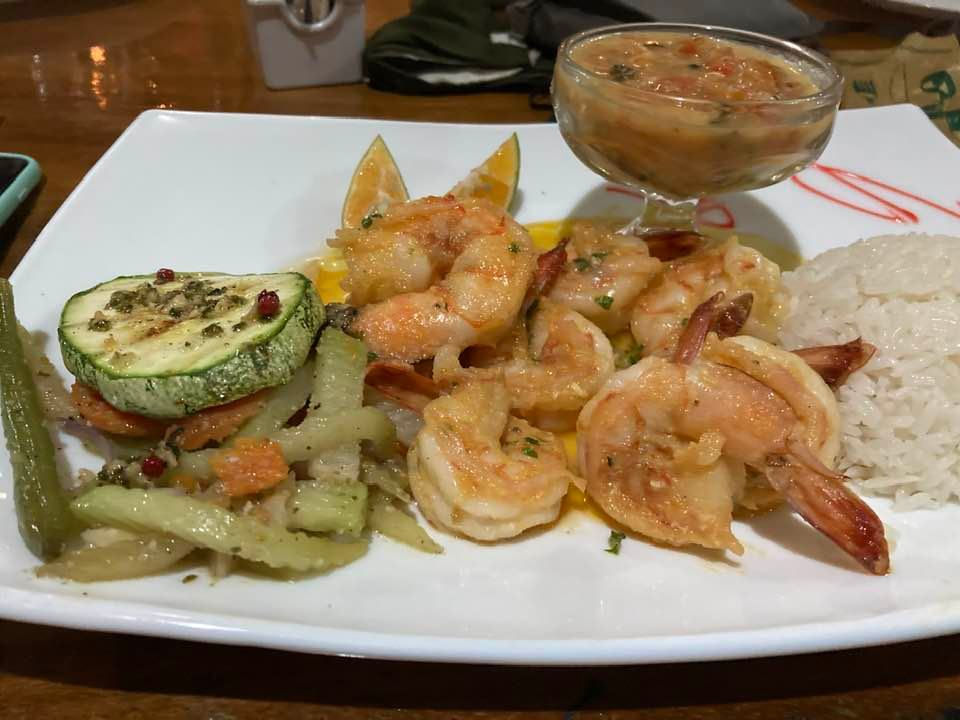
Day #13
The last day ended with a boom, literally and figuratively. We went on the most amazing ride on an outrigger, I don’t have too many pictures as my phone was in the dry bag, but more may come later. This activity was an absolute highlight! We paddled the large canoes from one beach to another. Along the way we saw a ton of pelicans and other wildlife. The beach where we docked was gorgeous and the water was delightful! I went snorkeling. Although our guide seriously underplayed it, I decided to try it anyway. Only two of us went. I LOVED it!! I saw schools of different fish with yellow markings, a catfish, mussels that seemed to glow blue, etc. Our guide held up a puffer fish and I, stupidly, went to touch it. It took a chunk of my finger. This is a story that could get bigger in the telling… a giant shark attacked then….
As I said the night ended with a boom. We were having a lovely farewell dinner with my delightful fellow travelers in this small restaurant when this guy stands up and begins to belt out a song. He had a very nice voice and for the first song it was enjoyable, however he continued and continued and continued and sat at our table. He was mistakenly invited by one of us. He kept bursting into VERY loud song in this tiny restaurant that resonated and asking for tips. I have included a very short video so you can hear and see him: https://www.facebook.com/share/v/1BnnbB6xwv/ He was odd. The owner escorted him out. It gave us another story to laugh about on the short ride back to the hotel. A finale!!
Thank you to Wendy our wonderful guide who seemed to know everything about the wildlife in the forests of Costa Rica and took great care of us, to William our driver who went above and beyond, and to my traveling buddies for helping to make it a trip to remember.
It’s a wrap!
Next up is Arizona!
-Susan R. Schlank


Comments